Alsace – The Land of Aromatic White Wines
Key Facts
Climate: Cool to moderate continental
Rainfall: 400–500 mm
Key grape varieties: Riesling, Gewurztraminer, Pinot Gris, Muscat, Pinot Blanc, Pinot Noir, Sylvaner
Viticulture: Single or double Guyot
Growing season: Late August– early December
Bottle: Flûte d’Alsace
Famous for: Aromatic white wines & Crémant d’Alsace
Grand Crus; 51 Grand Cru vineyards
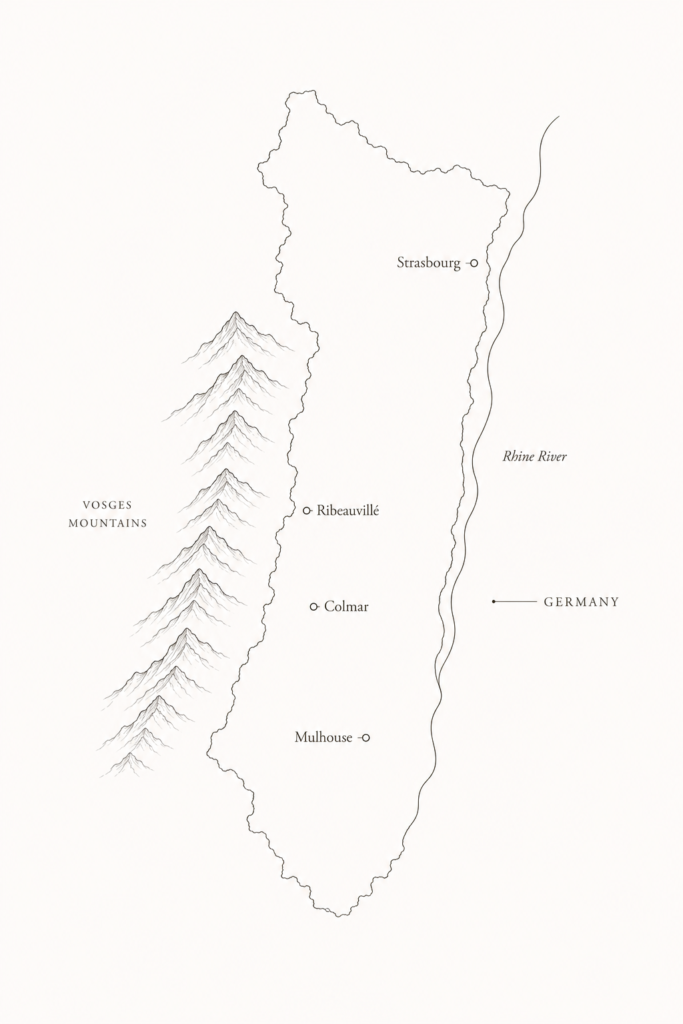
Alsace is located in northeastern France, situated between the Vosges Mountains and the Rhine River along the German border. The region has a long history of viticulture dating back to Roman times. Over the centuries, it changed hands between France and Germany multiple times, shaping its culture, architecture, and winemaking traditions.
Unlike most French wine regions, Alsace is known primarily for varietal wines. Riesling, Gewurztraminer, Pinot Gris, and Muscat are among its most important grape varieties, and the wines are typically labeled by grape variety rather than appellation.
Geography & climate
Alsace has a cool to moderate continental climate with a significant diurnal range (the difference between daytime and nighttime temperatures). Cool nights help preserve acidity in the grapes, while the northern latitude (47-49 °N) promotes slow, even ripening. Despite its northerly location, grapes ripen successfully thanks to the rain shadow effect of the Vosges Mountains, the region’s unique geology and favorable natural conditions. The Vosges Mountains to the west act as a barrier against Atlantic weather systems, making Alsace one of the driest and sunniest wine regions in France, with annual rainfall averaging only 400–500 mm. Alsace is also a pioneer of organic and biodynamic viticulture, with a growing proportion of its vineyards farmed under certified sustainable practices.
Soils
Alsace is part of the Rhine Rift Graben, and because of its rich geological history, the region has a diversity of soil types–the 13 major soils include granite, schist, limestone, alluvial, clay, marl, sandstone. The remarkable diversity of soils allows different grape varieties to thrive in sites best suited to their growing requirements.
Viticulture
The region’s principal training method is Guyot– either single or double. Due to the risk of spring frosts, vines on the plains are trained high from the ground, while vines grown on the slopes are trained low to benefit from radiated heat and maximize sun exposure. The best vineyards are found on the steepest slopes with south or southeast exposure.
The region can be divided into three main vineyard zones: the plains, the foothills of the Vosges Mountains, and the slopes. Grapes grown on the plains are primarily used for Crémant d’Alsace. In contrast, grapes grown in the foothills and on the slopes are typically hand-harvested and used for premium still varietal wines.
Grape varieties
The region’s most important grape varieties are Riesling, Gewurztraminer, Pinot Gris, Muscat, Pinot Blanc, Sylvaner, and Pinot Noir. Together, they form the foundation of Alsace’s distinctive wine styles.
Riesling– Dry, high acidity, citrus, stone fruit, mineral.
Gewurztraminer– Highly aromatic, lychee, rose petals, spice.
Pinot Gris/ Pinot Grigio– Rich, full-bodied, orchard fruit, smoke.
Muscat– Fresh, floral, fresh grape aromas, usually dry. The two principal varieties are Muscat Blanc à Petits Grains & Muscat Ottonel.
Pinot Blanc– Versatile, fresh, the principal grape variety used in Crémant d’Alsace.
Sylvaner– Light-bodied, crisp, herbal, especially successful on limestone soils and authorized in Zotzenberg Grand Cru.
Pinot Noir– The region’s only major red grape, producing elegant still red wines and Crémant d’Alsace Rosé.
Because each grape variety ripens at a different pace, the harvest season extends from late August through early December. Grapes destined for Crémant d’Alsace are harvested first to preserve their naturally high acidity, while fruit intended for late-harvest wines remains on the vine longer, allowing sugars and flavors to concentrate.
Alsace is best known for its white wines, which accounts for approximately 80% of production. Most are produced as varietal wines in either dry or sweet styles. The region also produces two traditional blended wines: Edelzwicker and Gentil. Edelzwicker can be made from any authorized grape varieties, vinified together or separately and the vintage year on the label is optional. Gentil must contain at least 50% noble grape varieties (Riesling, Pinot Gris, Gewurztraminer, Muscat). Each variety is vinified separately before blending, and the vintage year must appear on the label.
As the region’s focus is on growing aromatic white grape varieties, the wines are usually fermented in stainless steel tanks or foudres (large wooden vats with capacity 260- 3000 US gallons). The wines were traditionally vinified to dryness. But increasing number of wines in off-dry style are being produced.
Vendanges Tardives and Sélection de Grains Nobles are special wine styles that may only be produced from the four noble grape varieties. Vendanges Tardives are late-harvest wines, from overripe and hand harvested berries. Sélection de Grains Nobles wines are produced from individually selected, overripe berries affected by noble rot ( Botrytis Cinerea ).
Appellation System
The region appellation system is divided into 53 AOCs– Alsace AOC. Crémant d’Alsace AOC and 51 Grand Cru AOCs. Alsace AOC (created in 1945, but implemented in 1962) accounts for approximately 64% of total production and serves as a regional broad catch all appellation. A plethora of grape varieties and styles can be made. Alsace Grand Cru AOCs was originally created in 1975 as a single AOC, but divided into individual AOCs in 2011, applies for dry and sweet styles of white wines (and dry red wines– as of 2021 vintage) and accounts for only 6% of Alsace’s total wine production. The authorized grape varieties are: Riesling, Gewurztraminer, Pinot Gris, Muscat, Sylvaner, and Pinot Noir. The Grand Cru status applies to a specific site, and the selected vineyards have centuries of winemaking traditions and must apply to certain requirements such as grape varieties included, soil types, sun exposure, vine density, higher minimum alcohol level.
Cremant d’Alsace AOC is a sparkling wine, made in the traditional method, where the second fermentation happens in the bottle, in which the wine is later sold. Most of the wines are blended, with Pinot Blanc the principal grape variety being used for cremant production. Sparkling rosé is made solely from Pinot Noir grapes.